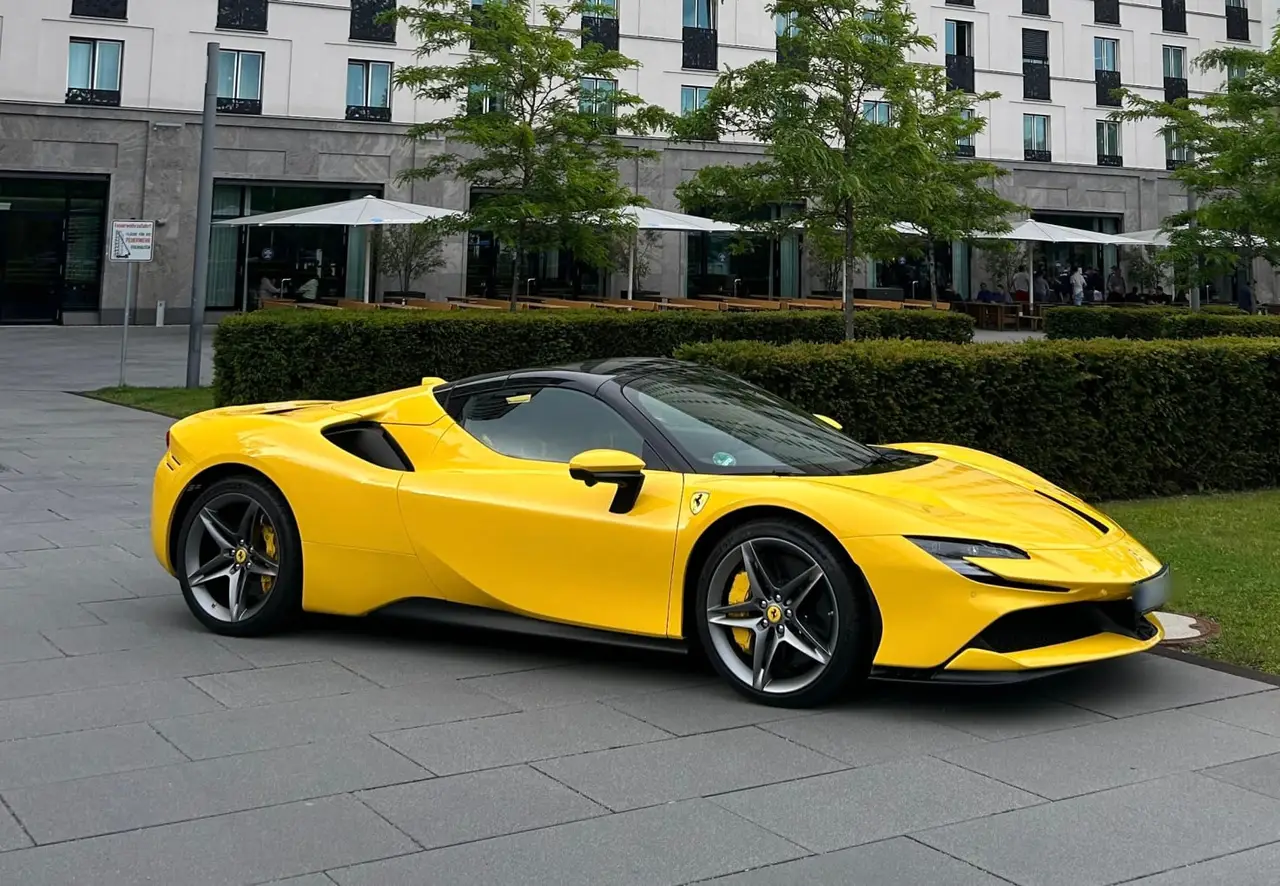
Ferrari SF90 Spider 2024
An open roof gives photographers more to work with outside the ceremony venue or on a short daylight drive between the ceremony and the reception, where weather and timing allow for it.
A wedding-day booking is rarely a single-car decision. The formal arrival, the photographs that follow, and the drive away from the reception each place different demands on a car — room for a dress and two guests, a clean open roof for pictures, or simply a quiet cabin for the couple to sit together for a few minutes. This page sets out how those different moments shape the choice of vehicle for a Milan wedding, rather than treating the day as one long rental with a single hero car attached to it.
The right car for a wedding depends less on a single idea of prestige and more on what a given stretch of the day actually requires. A formal arrival favours a composed, closed cabin; a short photography stop in daylight can call for an open roof; a group travelling together needs room that a two-seat body simply does not have. Working out how many separate movements the day contains — and who travels in each one — is usually the fastest way to settle which body style belongs where.
An open roof gives photographers more to work with outside the ceremony venue or on a short daylight drive between the ceremony and the reception, where weather and timing allow for it.
A sport-bodied car suits a brief, focused movement — leaving the ceremony or arriving at the reception — where the drive itself is part of the moment rather than a longer transfer between distant venues.
A car matched to the schedule — who is travelling, how formal the arrival should feel, and how much of the day is spent in photographs.
An open roof gives photographers more to work with outside the ceremony venue or on a short daylight drive between the ceremony and the reception, where weather and timing allow for it.
Before choosing a car, it helps to list the day's actual movements — getting-ready location to ceremony, ceremony to photographs, photographs to reception, reception to departure — and decide which of those genuinely need a dedicated vehicle versus which can share one.
Some Milan weddings include a stretch of photographs or travel beyond the city, perhaps toward Lake Como or into the Franciacorta area; if that forms part of the plan, it is a further movement to set alongside the ceremony and reception, with its own timing and vehicle role to work out.
Deciding whether parents, siblings or the bridal party travel in the same vehicle as the couple, or separately, changes how many cars the day needs and what role each one plays — this is worth settling early rather than assuming it will sort itself out on the day.
A late-evening departure from the reception is a different kind of movement from the morning arrival — shorter notice, lower light, and often a smaller group — and is worth planning as its own stage rather than an afterthought to the rest of the day.
This first movement usually sets the tone for the day's arrival — the priority is normally comfortable access for the person getting in, whatever they are wearing, rather than speed or distance.
Where the two venues sit some distance apart, the couple sometimes takes a short drive alone before the group arrives at the reception; an open-roof option suits this if the timing and weather line up.
Parents, bridal-party members or anyone carrying bags or gifts often need a separate movement from the couple's own car, which is where a higher-capacity vehicle earns its place in the day.
The final movement of the night tends to be smaller and later than the rest of the day — worth confirming separately, since it is easy to assume it will take care of itself once the celebration is underway.
Send the wedding date, the ceremony and reception locations, and roughly how the day is shaped, so the movements involved can be understood from the start.
Based on those movements, suitable body styles are considered against what each stage of the day actually needs — a formal arrival, an open-air drive, or extra seats for family.
Once a car or cars are selected, the booking-specific details are confirmed for the date in question.
The agreed vehicle or vehicles are ready for the confirmed start point and time, following the sequence set out in advance.
A few details help narrow down which car, or cars, fit a given wedding day.
A quick read of what most rental clients ask before booking.
That depends on how many separate movements the day includes. A wedding with one venue and a small group may only need one car for the arrival and departure; a day split across a ceremony, a photography stop and a separate reception venue, with family travelling alongside the couple, often needs more than one. Set out the day's structure when enquiring so this can be worked out properly.
Yes, a wedding booking can include travel to locations such as Lake Como or the Franciacorta area. Outline the full itinerary and timings when enquiring, so the right vehicle role is matched to each leg of the journey rather than just the stop inside the city.
Decoration requirements should be discussed before the booking is finalised so the proposed setup can be reviewed against the vehicle in question.
Earlier enquiries give more flexibility over which vehicles are still open for your date. A confirmed date, venue and rough timetable make it easier to match a car to the day sooner rather than later.
It can, provided the gap between the two allows for the drive and any stop in between. Share the timing between the ceremony and the reception so the vehicle's movements can be mapped against it rather than assumed.
Tell us the date, the ceremony and reception locations, and which parts of the day need a car — the vehicle roles can be worked out from there.